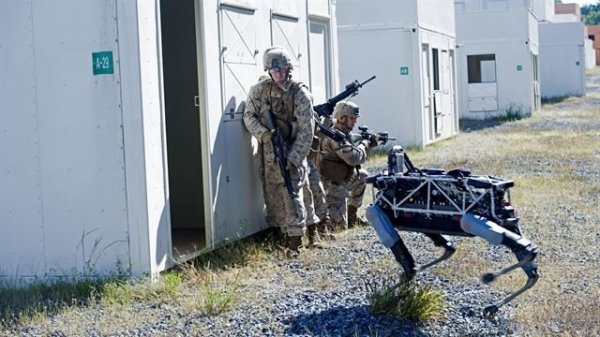
The US Marine Corps spent the weekend putting Boston Dynamics' four-legged Spot robot through its paces at Marine Corps Base Quantico in Virginia, testing whether the machine can operate effectively alongside infantry units in diverse scenarios. The trials, conducted with support from the Defense Advanced Research Projects Agency (DARPA), marked a significant step in exploring how legged robots might integrate into modern ground combat.
Spot, unveiled by Boston Dynamics—a subsidiary of Google—in February of this year, was brought to the base by a DARPA team. The agency has a history of working with Boston Dynamics, having previously tested the larger BigDog quadruped, which paved the way for the current evaluation. The weekend drills focused on assessing Spot's agility, durability, and responsiveness in field conditions, with marines observing how the robot handles rough terrain and close-quarter coordination.
Captain James Pineiro, head of the Marine Corps Warfighting Lab's Quantico branch, expressed optimism about the robot's performance. He noted that marines have been highly receptive to the technology and have already suggested a range of potential applications, from reconnaissance to logistics support. Pineiro emphasized that the positive feedback from handlers indicates a promising future for robotic systems in enhancing the warfighting capabilities of dismounted infantry.
From BigDog to Spot: A Legacy of Robotic Innovation
The Marine Corps' interest in Spot builds on years of collaboration between DARPA and Boston Dynamics, which has produced a series of experimental robots designed for military use. BigDog, a larger four-legged robot, was among the first to demonstrate the potential of legged locomotion in rough terrain, but its noise and mechanical complexity limited practical deployment. Spot, by contrast, is designed to be quieter and more agile, making it better suited for operations where stealth and adaptability are critical.
The weekend trials at Quantico are part of a broader effort by the Marine Corps to evaluate emerging technologies that could reshape infantry tactics. While the service has not announced formal procurement plans, the positive reception from marines suggests that robots like Spot may eventually complement—or in some cases replace—traditional roles, such as those performed by military working dogs. However, officials caution that field testing is still in its early stages, and much work remains before any system is deployed operationally.
For now, the focus is on gathering data and feedback from the troops who would ultimately use such machines. As Captain Pineiro noted, the marines' enthusiasm is a good sign, but the real test lies in how well the robot performs under the unpredictable conditions of actual combat. The coming months will likely see further evaluations, as the Marine Corps continues to explore the potential of robotic technology to enhance the effectiveness of its infantry forces.
Comments
Sign in to leave a comment
No account? Create one
No comments yet.