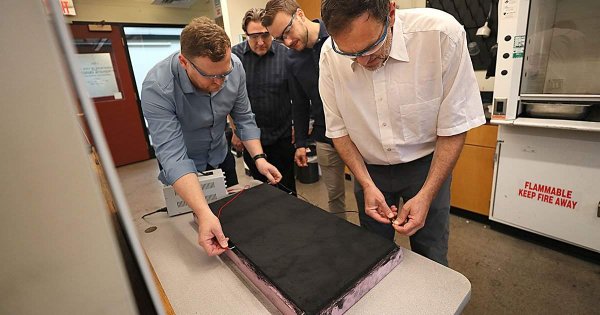
Researchers at MIT have developed a modified concrete that can store electrical energy, a potential complement to conventional batteries for managing fluctuating renewable power. The material, described by BBC reporting, combines water, cement, and carbon black—a conductive material used in tire manufacturing—to create a supercapacitor.
Supercapacitors charge and discharge quickly but store far less energy than lithium-ion batteries. That trade-off makes them unsuitable for long-term storage but potentially useful for rapid bursts of power or grid support. MIT researcher Damian Stefaniuk told the BBC the technology could help address "the storing of renewable energy" if it can be scaled up.
The proof-of-concept supercapacitor currently holds enough energy to power a 10-watt LED for 30 hours. Stefaniuk said the material could eventually form walls, foundations, or columns that both support a structure and store energy inside it. Roads built with the carbon-cement mix could also charge electric cars wirelessly, reducing reliance on conventional chargers.
Scaling Hurdles Remain
The team is planning a 1,590-cubic-foot version that Stefaniuk claims could meet the daily energy needs of a residential house. But moving from lab scale to real-world deployment often introduces problems, according to Teesside University engineering professor Michael Short. He told the BBC that manufacturing complexities, resource scarcities, or the underlying physics and chemistry can create obstacles at larger scales.
Beyond energy density, supercapacitors also tend to discharge quickly, a characteristic that limits their use for sustained storage. The MIT work is at an early stage, and no timeline for commercial deployment was provided in the source material.
Editorial Notes