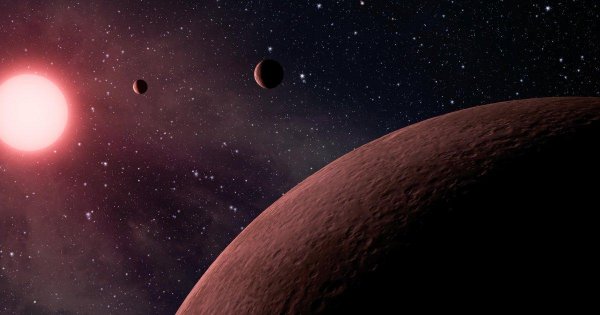
Moons are common throughout our solar system, but whether any exist beyond it had remained unknown until now. On Wednesday, Columbia University researchers announced they had found the first evidence of an exomoon, a moon orbiting a planet outside Earth's solar system.
The work began with a survey of 284 transiting planets, those that pass between a star and an observing instrument, in this case NASA's Kepler space telescope. When a planet crosses in front of a star, it causes a measurable dip in the star's brightness, which astronomers use to deduce details such as a planet's size and composition. For Kepler-1625b, a Jupiter-sized planet roughly 4,000 lightyears from Earth, the Kepler data differed from the typical exoplanet signal, suggesting the planet might have a moon.
The Columbia team then turned to the more powerful Hubble telescope to study Kepler-1625b, looking for additional dimming that would confirm the exomoon or any sign that it was affecting the planet's gravity. They found both.
Despite that evidence, the researchers describe their findings as preliminary and say future studies must confirm them. "We are trying to be cautious with our claims at this point… we want to see a little more before we come out and say, 'Yes, this thing is definitely there,'" researcher Alex Teachey told reporters during a press briefing. "In that sense, we are not cracking open champagne bottles just yet on this one."
As of this week, further scrutiny of Kepler-1625b is expected. The researchers' caution leaves the central question, whether the exomoon is definitely present, unresolved pending additional observations.
Editorial Notes