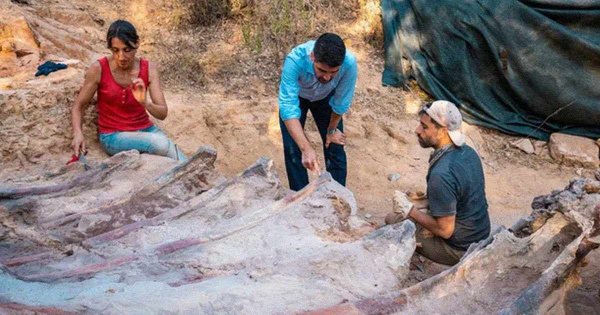
A property owner in Pombal, Portugal, has unearthed what may be the largest dinosaur fossil ever discovered in Europe, according to a statement from the University of Lisbon. The fossil, belonging to a sauropod, measures approximately 82 feet long and stood nearly 40 feet tall, with an estimated age of 100 to 160 million years.
The discovery began in 2017 when the owner found bone fragments during construction work in his yard and contacted the university's research team. Researchers conducted an initial excavation that same year and returned in 2022 to continue extracting the remains, the university said Wednesday.
Elisabete Malafaia, a postdoctoral researcher at the Faculty of Sciences of the University of Lisbon, noted the exceptional preservation of the ribs. "It is not usual to find all the ribs of an animal like this, let alone in this position, maintaining their original anatomical position," she said in the statement. "This mode of preservation is relatively uncommon in the fossil record of dinosaurs, in particular sauropods, from the Portuguese Upper Jurassic."
Sauropods were herbivorous dinosaurs known for their long necks and tails, and thick, strong forelimbs. Recognizable species include Brachiosaurus altithorax and Giraffatitan brancai, as well as the Portuguese Late Jurassic species Lusotitan atalaiensis, found in the country's West region.
The excavation team comprises both Portuguese and Spanish researchers. Further study of the fossils may provide additional insights into sauropods from the Late Jurassic period.
Editorial Notes