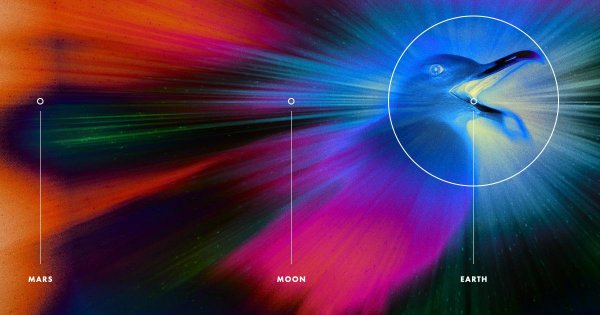
Light seems instantaneous to people on Earth, but a new animation by James O'Donoghue, a planetary scientist at the Japan Aerospace Exploration Agency, shows how that speed becomes a slow crawl across cosmic distances. The visualization follows pulses of light from Earth to the Moon and then to Mars, where the wait stretches to about three minutes.
O'Donoghue, who previously worked for NASA, released a trio of speed-of-light animations in January 2019 while at the agency. The new animation revisits that approach, starting with a pulse of light leaving Earth and disappearing off-screen in under a second. Zooming out, the same light takes a brief moment to reach the Moon. Further out, viewers wait roughly three minutes for the pulses to reach Mars. O'Donoghue stops the demonstration there.
The animation underscores a distinction that is easy to overlook: the speed of light is the theoretical speed limit of the universe, yet spacecraft cannot approach it. Even at that limit, journeys between planets take minutes, not instants. O'Donoghue's earlier NASA animations made a similar point on a cosmic scale.
Editorial Notes