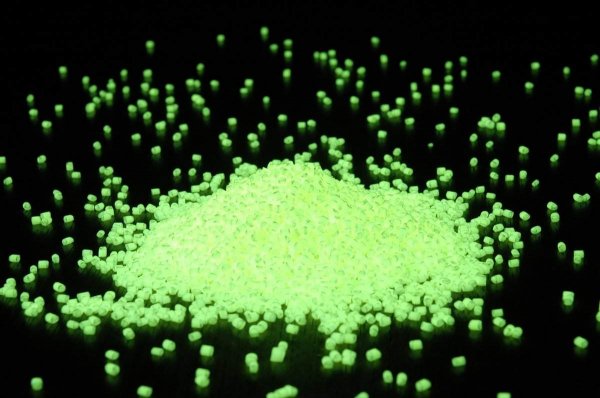
Researchers at Kyushu University's Center for Organic Photonics and Electronics Research (OPERA) in Japan have designed an organic glow-in-the-dark material that emits light for more than one hour, according to research published in the journal Nature. The achievement marks a significant advance over previous organic phosphorescent materials, which had only managed light emission lasting a few minutes.
Traditional glow-in-the-dark products rely on inorganic compounds that require rare metals like europium and dysprosium, making them expensive to produce. The OPERA team instead used organic carbon materials—similar to those found in plastics and pigments—which are less costly and do not need high temperatures to manufacture. The researchers melted two molecules together into a film: one that donates electrons and another that accepts them.
"Many organic materials can use energy absorbed from light to emit light of a different color, but this emission is generally fast because the excitation energy is stored directly on the molecule that produces the emission," Ryota Kabe, lead author of the study, said in a press release. In the new mixture, electron acceptors absorb light and use excess excitation energy to remove an electron from donor molecules. This repeated give-and-take builds up separated electrical charges that can persist for extended periods.
"Our mixtures store the energy in electrical charges separated over a longer distance. This additional step allows us to greatly slow down the release of the energy as light, thereby achieving the glow-in-the-dark effect," Kabe said.
Potential Applications and Remaining Challenges
According to Chihaya Adachi, director of OPERA, the first expected impact is in large-area applications such as glowing corridors or roadways for added safety. "With organics, we have a great opportunity to reduce the cost of glow-in-the-dark materials," Adachi said in the press release. "After that, we can start thinking about exploiting the versatility of organic materials to develop glow-in-the-dark fabrics and windows, or even bio-compatible probes for medical imaging."
However, the new process is sensitive to oxygen and water exposure. The researchers are investigating protective barriers and new molecular structures that could further extend light emission duration. Commercial application will require additional work to address these stability issues.
Editorial Notes