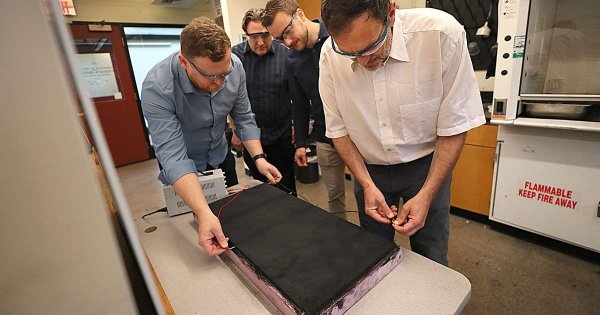
Researchers at the Massachusetts Institute of Technology have developed a concrete composite that can store electrical energy, a breakthrough that could one day allow building foundations and walls to function as batteries. The material, made from water, cement, and carbon black—a conductive powder commonly used in tire manufacturing—acts as a supercapacitor, enabling rapid charge and discharge cycles.
The proof-of-concept, led by MIT researcher Damian Stefaniuk, was detailed in a report by the BBC. Stefaniuk and his colleagues mixed the ingredients to form a supercapacitor, a device that stores energy through electrostatic fields rather than chemical reactions, unlike conventional lithium-ion batteries. While supercapacitors typically hold less energy per unit weight and discharge quickly, they excel at delivering bursts of power, making them a potential complement to batteries in managing fluctuating renewable energy sources like solar and wind.
Stefaniuk emphasized the significance of the work, telling the BBC, “If it can be scaled up, the technology can help solve an important issue—the storing of renewable energy.” The concept has already sparked ideas for practical applications, including road surfaces that could wirelessly charge electric vehicles as they drive, reducing dependence on stationary charging stations. More ambitiously, the material could be integrated into building structures, allowing walls, foundations, or columns to serve dual purposes: providing structural support while storing electricity.
From Lab Scale to Real-World Application
Despite the promise, the technology remains in its early stages. The current prototype, a small supercapacitor, can only store enough energy to power a 10-watt LED for 30 hours. Scaling up to meet the daily energy needs of a typical household would require a significant leap in capacity and efficiency, as supercapacitors are far less energy-dense than lithium-ion batteries and tend to lose their charge rapidly.
Stefaniuk’s team is already planning a larger demonstration: a 1,590-cubic-foot version intended to store enough energy for a residential home. However, moving from a laboratory bench to a functional building material poses considerable challenges. Michael Short, a professor of engineering at Teesside University, cautioned that “new discoveries are problematic when considerations are made to move from lab or bench scale to wider deployment at larger scales and volumes.” He cited manufacturing complexities, potential resource scarcities, and fundamental physics or chemistry limitations as likely hurdles.
If these obstacles can be overcome, the implications for the electrical grid could be substantial. By embedding energy storage directly into buildings and infrastructure, the material could ease pressure on the grid, particularly during peak demand or when renewable generation dips. It could also reduce the need for separate battery systems in homes, potentially lowering costs and simplifying energy management.
For now, the research represents a proof of concept rather than a market-ready solution. The team’s next steps will focus on scaling the technology and addressing the engineering challenges highlighted by Short. As Stefaniuk noted, the potential to store renewable energy in the very structures we inhabit is an enticing prospect, but turning that vision into reality will require sustained research and development.
Comments
Sign in to leave a comment
No account? Create one
No comments yet.