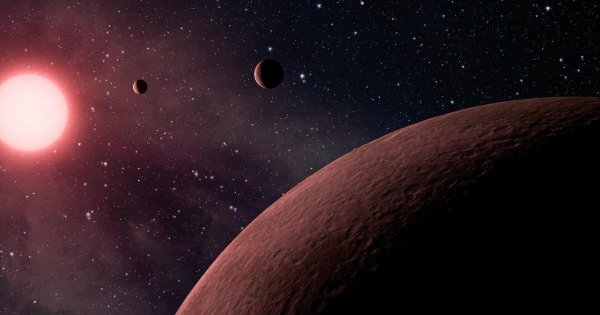
For the first time, astronomers may have found a moon orbiting a planet outside our solar system. A team from Columbia University announced Wednesday that they have detected strong evidence of an exomoon around Kepler-1625b, a Jupiter-sized planet located roughly 4,000 light-years from Earth.
The possible discovery stems from a survey of 284 transiting planets observed by NASA's Kepler space telescope. When a planet passes in front of its star, it causes a slight dimming of the star's light. By analyzing these dips, scientists can infer details about the planet, such as its size and composition. In the case of Kepler-1625b, the data showed an unusual pattern—an additional dimming that could not be explained by the planet alone.
To investigate further, the Columbia team used the Hubble Space Telescope to monitor Kepler-1625b more closely. They looked for two things: a second, smaller dip in starlight that would indicate a moon, and a gravitational wobble in the planet's motion that a large moon would cause. Both were observed, adding weight to the exomoon hypothesis.
Despite the promising signals, the researchers are careful not to overstate their conclusion. Alex Teachey, one of the lead researchers, told reporters during a press briefing, “We are trying to be cautious with our claims at this point… we want to see a little more before we come out and say, ‘Yes, this thing is definitely there.' In that sense, we are not cracking open champagne bottles just yet on this one.”
The findings, while preliminary, have captured the attention of the scientific community. If confirmed, they would mark a significant milestone in the search for moons beyond our solar system—a question that has remained open until now. Moons are abundant in our own solar system: Earth has one, Mars has two, and Jupiter and Saturn each have dozens. But whether such satellites exist around planets in other star systems has been unknown.
Why This Matters for Exoplanet Research
The potential exomoon is not just a curiosity. Studying moons can offer insights into the formation and evolution of planetary systems. A large moon, for instance, could affect a planet's orbit and rotation, influencing its climate and habitability. The Kepler-1625b system, with its possible moon, could serve as a natural laboratory for testing theories about how moons form and survive around giant planets.
Still, the evidence is not yet conclusive. The team's analysis is based on observations from two telescopes, but the signal is subtle. Future studies, possibly using more advanced instruments, will be needed to confirm the existence of the exomoon and to rule out other explanations, such as a second planet in the system.
As the scientific community turns its attention to Kepler-1625b, the coming months and years may bring further clarity. For now, the possibility of a moon beyond our solar system remains an intriguing prospect—one that could reshape our understanding of where moons can exist in the universe.
Comments
Sign in to leave a comment
No account? Create one
No comments yet.