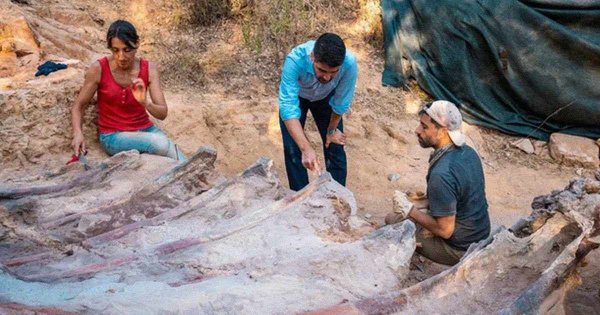
A routine construction project in a Portuguese backyard has unearthed what may be the largest dinosaur skeleton ever found in Europe. The University of Lisbon announced on Wednesday that the fossilized remains of a sauropod, measuring roughly 82 feet in length and standing about 40 feet tall, were recovered from a property in Pombal, a town in central Portugal.
The discovery dates back to 2017, when the landowner first noticed bone fragments while carrying out building work on his property. He contacted the university's research team, which launched an initial excavation that same year. A second, more extensive campaign was conducted this year to fully extract the ancient bones.
According to the university's statement, the skeleton is believed to belong to a sauropod, a group of long-necked, herbivorous dinosaurs that roamed the Earth during the Jurassic and Cretaceous periods. The fossil's age is estimated at between 100 and 160 million years, placing it in the Late Jurassic to Early Cretaceous epochs. Despite its antiquity, the bones are in notably good condition.
“It is not usual to find all the ribs of an animal like this, let alone in this position, maintaining their original anatomical position,” said Elisabete Malafaia, a postdoctoral researcher at the Faculty of Sciences of the University of Lisbon, in the statement. “This mode of preservation is relatively uncommon in the fossil record of dinosaurs, in particular sauropods, from the Portuguese Upper Jurassic.”
The excavation involved a team of Portuguese and Spanish researchers, who carefully documented the arrangement of the ribs and other skeletal elements. The fact that the ribs were found in their natural anatomical position is particularly significant, as such articulation is rare in the fossil record, especially for sauropods.
Sauropods were among the largest land animals to have ever lived, characterized by their massive bodies, long necks, and tails. Unlike carnivorous theropods such as Tyrannosaurus rex, they were plant-eaters, with thick, sturdy forelimbs that supported their enormous weight. Well-known relatives include Brachiosaurus altithorax and Giraffatitan brancai, as well as Lusotitan atalaiensis, a species native to the Late Jurassic of Portugal's West region.
Rare Preservation Sheds Light on Jurassic Ecosystems
The exceptional preservation of this skeleton offers a rare opportunity to study the anatomy and behavior of sauropods in the Iberian Peninsula. The researchers hope that further analysis will provide new insights into the diversity and ecology of these giants during the Late Jurassic period.
While the full extent of the skeleton is still being assessed, the find underscores the scientific value of private land in paleontological discoveries. The University of Lisbon has not yet announced plans for a public display, but the research team is expected to publish detailed findings in the coming months.
For now, the Pombal sauropod stands as a testament to the prehistoric giants that once roamed what is now Portugal, and a reminder that extraordinary discoveries can happen in the most unexpected places.
Comments
Sign in to leave a comment
No account? Create one
No comments yet.