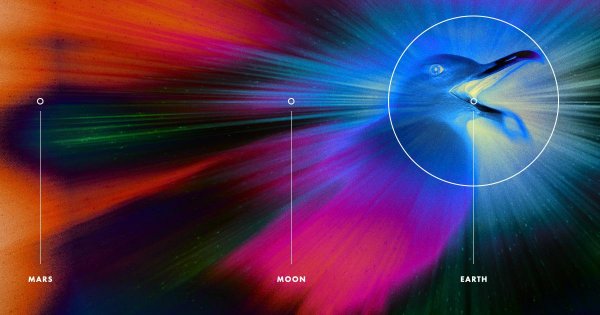
For most people, light appears to travel at an instantaneous pace, but a new animation from a Japan Aerospace Exploration Agency (JAXA) scientist shows how that perception shifts dramatically when viewed on a cosmic scale. The video, created by planetary scientist James O’Donoghue, illustrates that even the universe’s ultimate speed limit becomes a slow crawl when distances stretch across space.
O’Donoghue, who previously worked at NASA, has a history of producing such visualizations. In January 2019, he released a set of three animations that similarly highlighted the relatively sluggish pace of light when measured against the vastness of the solar system. His latest work takes a different approach, starting with a familiar perspective before pulling back to reveal the bigger picture.
The animation opens with a pulse of light emanating from Earth, which vanishes off-screen in less than a second—a nod to how rapid light seems in our daily experience. But the view then expands to show the same pulse taking a noticeable moment to reach the Moon. The perspective widens further, and viewers are left waiting for about three minutes as the light pulses travel to Mars. The video stops there, sparing audiences the even longer delays that would accompany journeys to the outer planets.
Why the Cosmic Scale Matters
The contrast between the near-instant local speed and the multi-minute interplanetary transit time underscores a fundamental challenge for space exploration. Even at light speed, which no spacecraft can approach, communication with distant probes or potential crewed missions would involve significant lag. The animation serves as a visual reminder of the vast distances that separate worlds, a factor engineers must account for when designing missions or planning deep-space operations.
O’Donoghue’s work has gained attention for its ability to make abstract scientific concepts tangible. By using simple animations, he translates complex physics into visuals that are accessible to a general audience. The new video, like its predecessors, aims to bridge the gap between human intuition and the reality of cosmic scales.
The animation also highlights the limitations of current propulsion technology. While light travels at about 300,000 kilometers per second, spacecraft like NASA’s Voyager probes take years to reach the same destinations that light crosses in minutes. This disparity is central to the challenges of interstellar travel, a topic that remains theoretical for now.
For those who have seen O’Donoghue’s earlier work, the new animation offers a fresh perspective on a familiar theme. It is a concise, thought-provoking piece that encourages viewers to reconsider their place in the universe, one pulse of light at a time.
Comments
Sign in to leave a comment
No account? Create one
No comments yet.