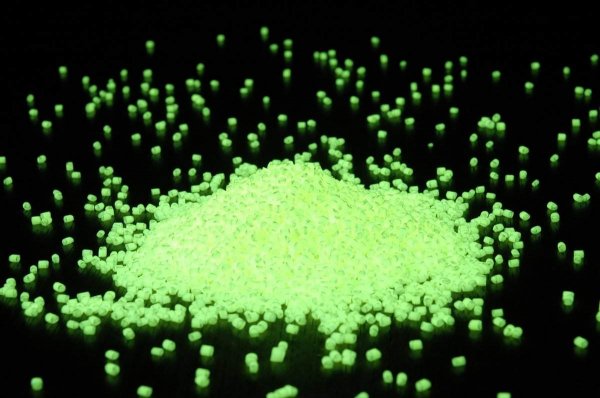
In a development that could make glow-in-the-dark products cheaper and more versatile, researchers at Kyushu University in Japan have engineered an organic film that emits light for more than an hour after being exposed to ambient light. The work, published in the journal Nature, addresses a key limitation of previous organic phosphors, which typically glow for only a few minutes.
The team, based at the Center for Organic Photonics and Electronics Research (OPERA), used carbon-based molecules—similar to those found in plastics and pigments—rather than the rare-earth metals like europium and dysprosium that are required for conventional inorganic phosphors. Those metals are costly and require high-temperature manufacturing, limiting their use in large-area applications.
Ryota Kabe, the study's lead author, explained that while many organic materials can absorb light and re-emit it as a different color, the emission is usually fast because the excitation energy is stored directly on the emitting molecule. To slow this process, his team melted together two complementary molecules: one that donates electrons and one that accepts them. The resulting film, when applied to organic substrates, was able to sustain light emission for over an hour.
The mechanism relies on a charge-separation process similar to that used in organic solar cells. The electron acceptor absorbs light and, with excess energy, removes an electron from the donor molecule. This repeated give-and-take builds up separated charges that remain stable in the mixture for a prolonged period. "Our mixtures store the energy in electrical charges separated over a longer distance," Kabe said in a press release. "This additional step allows us to greatly slow down the release of the energy as light, thereby achieving the glow-in-the-dark effect."
Chihaya Adachi, director of OPERA, noted that the organic approach could significantly reduce the cost of glow-in-the-dark materials, making them practical for large-area uses. "The first place we expect to see an impact is large-area applications, such as glowing corridors or roadways for added safety," he said. "After that, we can start thinking about exploiting the versatility of organic materials to develop glow-in-the-dark fabrics and windows, or even bio-compatible probes for medical imaging."
Challenges Before Commercial Use
Despite the promise, the new material is sensitive to oxygen and water, which can quench the luminescence. The researchers are now exploring protective barrier coatings and are also investigating new molecular structures that could extend the emission duration even further. The study is a proof of concept, and commercial products are not yet available.
The findings add to a growing body of research in organic photonics, where the goal is to replace expensive inorganic compounds with cheaper, more flexible carbon-based alternatives. If the stability issues can be resolved, the technology could find its way into safety signage, medical imaging, and even everyday items like stickers and clothing.
Comments
Sign in to leave a comment
No account? Create one
No comments yet.